All articles
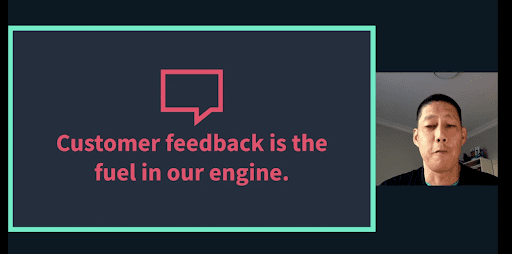
Kevin Hwang - Customer Feedback is the Fuel in our Engine
This is a talk about the importance of customer feedback when it comes to documentation.
Published
Category
Kevin Hwang - Customer Feedback is the Fuel in our Engine
Catherine Heath | October 13, 2021
This is a summary of a talk given at Write the Docs Prague 2021.
Kevin has coaching certifications in both volleyball and tennis, and loves linguistics. He already speaks English, Chinese and French. He’s a documentarian at Splunk in California.
Coaching is related to technical writing because you can’t do it alone. The most important person is at the end: the athlete, and the customer. Therefore, the most important feedback comes from the athlete, and the customer.
It’s really hard to have useful documentation without feedback from the customer. Customer feedback is the ultimate gauge for how useful the documentation is. Docs that help customers solve problems, improve their performance and develop community can be labelled “good” documentation.
He has used customer feedback to engage and grow the product.
The writing process involves hunting and gathering information, writing and reviewing, and publishing. However, this process does not involve the voice of the customer. Before Splunk he had never worked anywhere that you could hear directly from the customer.
Documentation is always a living breathing entity that changes and evolves over time. The thing that fuels the change is customer feedback.
Documentation is valuable when:
The customer can quickly and easily find what they’re looking for
When it helps them solve a problem
It helps them do their jobs more efficiently
It teaches them something new
As a writer, you have the opportunity to educate your customer to become an expert in your particular area.
Qualities that make documentation valuable can’t really be quantified by any data. If someone is visiting your documentation a lot, how do you know if the documentation is really helping them? The answer is to get their feedback.
1. Why?
Kevin talks about how to get value out of doc feedback. There’s tremendous opportunity to add a lot of value to your documentation, product and organization. Feedback proves that customers are actually reading your documentation. At Splunk, they’ve published a book that’s called The Product is the Docs - the product is unusable without documentation.
Feedback helps you as a technical writer feel closer to the people actually using your documentation. It helps writers empathize with the customer. When customers give feedback, they want to know that their voice is heard.
Documentation feedback creates a sense of community. Many folks are struggling with the same problems, issues and frustrations. Feedback from one customer could help hundreds of customers using your docs.
If your company has any sort of online community, social media or blogs, chances are there’s chatter about your documentation. Customers can discuss your docs with each other, and imagine that it helps them solve a problem.
Customer feedback proves the value of your documentation. If you’re a hiring manager looking to increase your writer headcount, feedback proves that customers are actually using the documentation. You can use feedback to demonstrate how important it is to grow your team, and fight the outdated stereotype that no one reads the docs.
2. Challenges?
Doc feedback is hard to fit in, because there is already a lot of work around the documentation. It can’t be planned for or scheduled and can be a little bit reactive. Some weeks, he may receive only two pieces of feedback, and others he might receive eight or nine.
Docs feedback may not be a priority, since maybe the product team has moved on to bigger and newer things. Customers don’t always upgrade to the latest version right away, and the feedback may relate to an earlier version.
Sometimes, the writer doesn’t know the answer to the customer’s question, and that’s a problem. Finding the answer may not be that easy and engineers are busy, so they might not have the time to help you get the answer. Sometimes, there may not even be an answer.
Occasionally, the real problem lies in the product itself. It’s nothing to do with the docs. He received feedback about a particular option in the user interface, and the engineering team informed that the feature didn’t work.
3. You can do it!
Group related feedback into buckets to help make it more organized. You can decide whether something is a doc issue, or a product design issue.
You can also work with your team to group feedback into buckets by priority. Something that would be immediate would be if a customer is unable to proceed further and it’s because of the docs or the product. Help them now.
Keep the customer in the loop with whatever you do. Customers took the time to submit feedback, so the least you can do is get back to them. It lets them know you take feedback seriously and they are likely to leave more feedback the next time they encounter an issue. These customers are also more likely to advocate on your behalf within the community.
Make sure you give the customer the opportunity to end the conversation. If a customer asks for something you don’t provide, let them know and ask if you can help with anything else. Give customers control over the interaction and let them know their voice is being heard.
Final remarks
Go and build your community!
1. Prioritize - Make it a priority across your company to embrace customer feedback. Make it easy for the customer to provide feedback.
2. Connect - When you get the feedback, connect with the customer. Keep them in the loops, and give them the chance to end the conversation.
3. Build - Use customer feedback to turbocharge your documentation with fresh ideas and perspectives.
{{snippet.authorCatherineHeath}}
{{snippet.Disqus}}

Written by
Catherine Heath
Catherine is a freelance writer based in Manchester who writes blogs, social media content, and copy. She also designs owl-based images. 🦉

Follow these 3 steps to improve your knowledge base
1
Get expert tips every month in your inbox
No spam, pinky promise.


2
Try the knowledge base software your team will fall in love with
Reduce tickets, make information easy to find.
Happier employees, happier customers.
3
Become the tech writer everyone respects
Check out our podcast, The Not-Boring Tech Writer.
How teams are using KnowledgeOwl
Loved by 3,200+ knowledge base authors in software companies around the world