All articles
Write the Docs: Level Up - Onboarding that enables writers to thrive – Nicola Yap
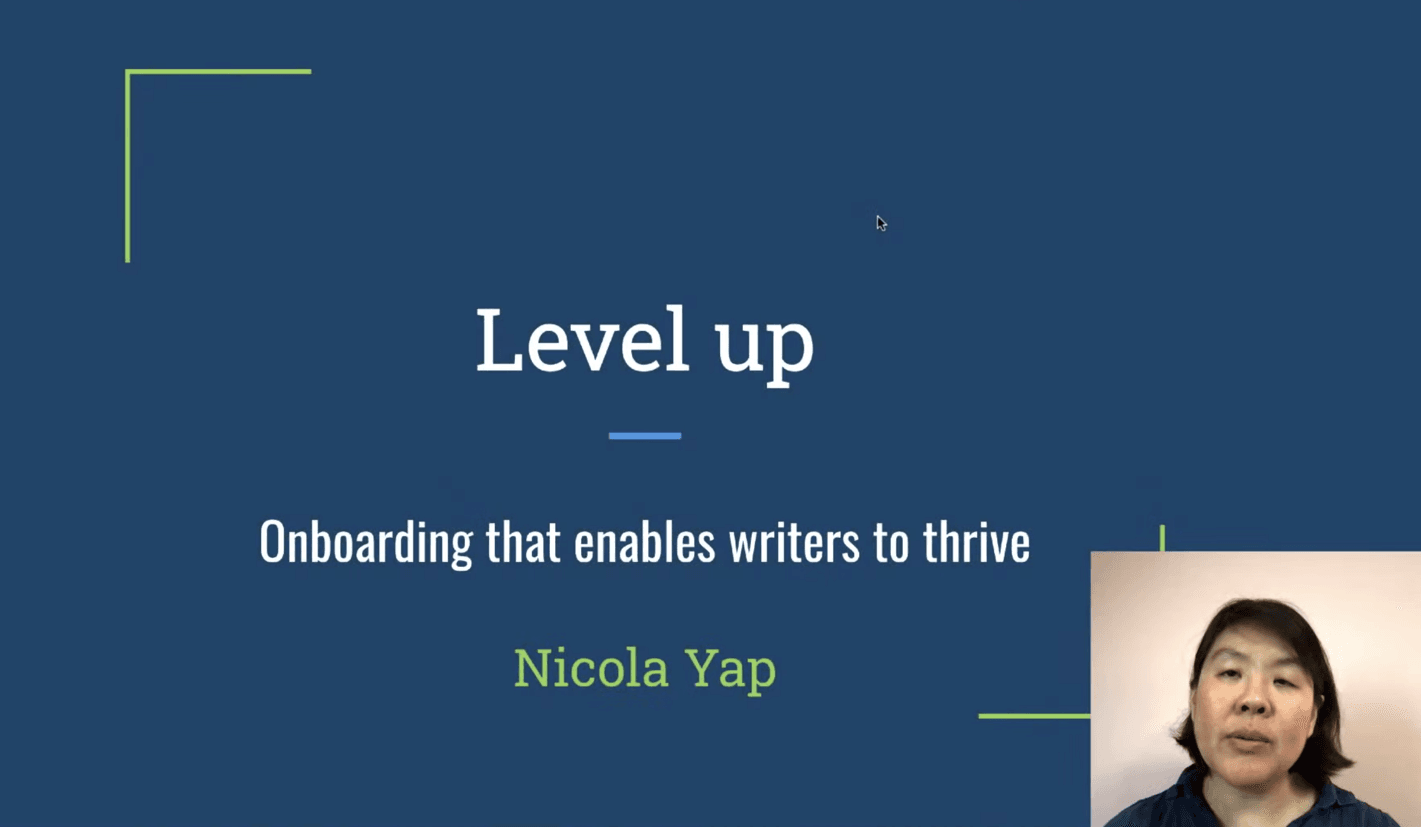
This Write the Docs Talk was given by Nicola Yap. Nicola has been in tech writing for over 20 years but joined Google in 2019. She’s co-lead of the Google Tech Writer Onboarding Team.
Published
Category
Write the Docs: Level Up - Onboarding that enables writers to thrive – Nicola Yap
Catherine Heath | April 28, 2021
This Write the Docs Portland 2021 talk was given by Nicola Yap. Nicola has been in tech writing for over 20 years but joined Google in 2019. She’s co-lead of the Google Tech Writer Onboarding Team. This talk was about creating a successful onboarding process to help new technical writers in your organization to thrive.
Lacking guidance as a technical writer
In every company Nicola has joined, there’s not been a lot of guidance in her role and responsibilities as a writer. Without clear guidance, you can get pigeonholed into the misconception that all you do is write, and suddenly find that your'e a copy editor for everyone else.
Sometimes, the documentation lifecycle and where writers contribute is also unclear and undefined. Stakeholders are not highlighted and there’s not as much buy-in to support the writer in getting their work done.
If there isn’t a clearly defined writer role and path, then writers aren't being set up to succeed.
Reinventing the wheel
A few months into her job, some people approached Nicola with content created for new writers. Teams were creating onboarding materials for new writers to help them figure out their role as a writer at Google. While these were useful efforts, there was a lot of repetition of effort.
Nicola approached her manager to ask for more onboarding for new writers at Google, which began a more cohesive onboarding process. Having this education in place was really important for providing everyone with a consistent experience.
In 2021, their focus has shifted from onboarding to ongoing education to address gaps that were starting to appear later in people's experiences.
The purpose of onboarding
According to Nicola, onboarding serves several purposes:
As a map to highlight the things that are important and hide the things that aren't.
To define and describe the pathways from where you are now to where you want to go.
To create a sense of belonging and community so the writer feels like they are valued and fit in.
To answer the question: Where do I go next after onboarding?
For documentation onboarding specifically, the onboarding should:
Clarify what types of content and deliverables the writers owns – for example, is it just product documentation or outreach such as blog posts or videos? This should also set boundaries so writers aren’t trying to field random requests to edit slides.
Describe who is involved throughout the documentation lifecycle, including what industry they might be in and the problems they’re trying to solve.
The writer's reporting structure/hierarchy and how that might impact the scope of their work or workflows.
Defining expectations for writers
Nicola stresses that onboarding should help writers understand what the overall expectations are of their contributions, such as working across teams that could include community outreach or mentoring. What are the opportunities for training and growth? How can you move laterally?
Nicola notes that it's okay if you don't have all these things established up front, since differently-sized organizations will have different needs.
If your organization has more established documentation practices, you’ll need to apply them to onboarding your new writers.
The goals of onboarding
Nicola recommends you set goals for the onboarding.
For example, as a result of onboarding, a writer should be able to:
Identify the stakeholders on their team
Describe users of the documentation
Find a bug they own
Make a change to the docs
Get reviewer feedback
Publish changes
Once you have your onboarding goals, you can put your content together. The onboarding they developed at Google focused on the writer role and tool/process education. They offered 60-minute live virtual classes, two facilitators, slides with highlights, speaker notes with details, and anonymous surveys after classes.
Beyond onboarding, work to shape your organization to better foster documentation culture:
Include the writer role in end-to-end team processes.
Establish a shared ownership for specific doc tasks.
Recognize the range of writer contributions to user success.
Recognize subject matter expert (SME) contributions to docs.
Provide templates and writing guidance to everyone.
Final remarks
We enjoyed Nicola's talk because onboarding really can make or break any employee's experience. Putting some thought into shaping that experience--either through documentation or just explicitly for documentarians--can go a long way to getting your writers productive and feeling welcomed and comfortable.
Watch the full talk here.
{{snippet.authorCatherineHeath}}
{{snippet.Disqus}}

Written by
Catherine Heath
Catherine is a freelance writer based in Manchester who writes blogs, social media content, and copy. She also designs owl-based images. 🦉

Follow these 3 steps to improve your knowledge base
1
Get expert tips every month in your inbox
No spam, pinky promise.


2
Try the knowledge base software your team will fall in love with
Reduce tickets, make information easy to find.
Happier employees, happier customers.
3
Become the tech writer everyone respects
Check out our podcast, The Not-Boring Tech Writer.
How teams are using KnowledgeOwl
Loved by 3,200+ knowledge base authors in software companies around the world