All articles
What is service knowledge management, and why does it matter for your support team?
Never heard of SKMS or KCS? You're not alone. But knowing the language of service knowledge management could change how you advocate for your team.

Photo by Vitaly Gariev
If you've never heard the term "service knowledge management," you're in good company. I hadn't either, until it came up in an internal conversation recently and sent me down a bit of a rabbit hole.
Turns out, service knowledge management (sometimes called SKMS, which stands for Service Knowledge Management System) is a real, established discipline. It originated in IT service management (ITSM) circles, but the concept applies broadly to any team whose job is to deliver consistent, high-quality service to others. Which, if you're reading this, probably sounds a lot like your job.
So let's break it down, and build up a little vocabulary along the way, because having the right words can make all the difference when you're trying to make the case for investing in your team's knowledge infrastructure.
The vocabulary you didn't know you needed
One of the most helpful things you can do as a support team lead isn't to immediately go out and implement a new system; it's to learn the language of the discipline you've already been practicing. Here are the key terms worth knowing:
SKMS (Service Knowledge Management System) is the overarching system your organization uses to store, manage, and surface knowledge throughout the service lifecycle. It's often not a single tool, but instead a collection of databases, documents, and data sources that together form your organization's central body of knowledge.
Think: your knowledge base, your internal wiki, your troubleshooting guides, your onboarding docs, and all the institutional knowledge those things are trying to capture.
DIKW hierarchy is a framework that sits at the heart of knowledge management thinking. It stands for Data → Information → Knowledge → Wisdom. The idea is that data generated by your team's activities gets processed into information, then into knowledge, and finally transforms into wisdom and insights that help you make better decisions. It's a useful model for thinking about why raw data isn't enough and why documentation and context matter so much.
KCS (Knowledge-Centered Service) is probably the most practical framework for support teams specifically. KCS is about getting the in-depth knowledge of your team out of their heads and onto the page by creating documentation that employees and customers can use without constantly asking the same questions. The core idea is that knowledge should be treated as a business asset, not an afterthought.
Every support interaction becomes an opportunity to create, reuse, and refine shared knowledge that helps teams work more efficiently and deliver faster, more consistent service. The methodology was developed by the Consortium for Service Innovation, which offers resources and certifications if you want to go deeper.
Tribal knowledge is probably the term that will resonate most with anyone who's been on a support team long enough. It's the knowledge that lives only in people's heads — the institutional memory that walks out the door when someone leaves, or never gets written down because it feels too obvious to document. SKMS and knowledge management practices exist in large part to address this problem — to dissolve information silos and provide an organization-wide platform where knowledge is shared rather than hoarded (even unintentionally).
Why support teams especially feel this pain
Support and customer service teams are often sitting on enormous amounts of institutional knowledge — and a lot of it lives in people's heads, scattered inboxes, or that one shared doc that nobody's touched since 2023.
When that knowledge isn't organized and accessible, the costs are real: slower resolution times, inconsistent answers, and the exhausting experience of reinventing the wheel every time a familiar question comes in. The same problem gets solved over and over by different people, and nobody has time for that.
Service knowledge management gives that problem a name, and more importantly, a framework for solving it.
You've probably already been doing this, just without the label
If your team has a knowledge base, an internal wiki, or even a well-loved FAQ doc, you're already practicing service knowledge management. You just might not have been calling it that.
There's something quietly powerful about giving a practice a name. It makes it easier to advocate for, easier to invest in, and easier to get buy-in from the people holding the purse strings.
"We need better documentation" can be a hard sell. "We need to invest in our service knowledge management strategy" sounds like the business case that it is.
So where do you actually start?
You don't need to overhaul everything at once. Here are a few practical places to begin:
Audit what you have. Before you build anything new, take stock of where your team's knowledge currently lives. Shared drives, Slack threads, email chains, people's heads. Map it out. You'll likely find more than you expected, and some of it may already be in pretty good shape.
Start capturing knowledge at the moment it's created. This is a core principle of KCS: when a support team member resolves an issue, the idea is to document it immediately, while it's fresh — creating a living knowledge base that grows more useful with each interaction. Even a rough note is better than nothing.
Prioritize what gets asked most. You don't need to document everything at once. Look at your support tickets and identify the questions that come in repeatedly. Those are your highest-value documentation targets.
Make findability a priority, not an afterthought. A knowledge base that nobody can navigate is just a very organized pile of things nobody reads. When you're building or improving your knowledge system, invest real time in structure, search, and how information is categorized.
Review and update regularly. Outdated documentation can be worse than no documentation because it erodes trust in the whole system. Solid guidelines for adding, reviewing, and updating knowledge items must be in place so that information stays accurate and relevant. Even a simple quarterly review cycle can make a big difference.
Where KnowledgeOwl fits in
We built KnowledgeOwl to be a knowledge base tool for teams who take documentation seriously. Over the years, it's become clear that service teams are often our people. They're the ones who feel the absence of good knowledge management most acutely, and who benefit most from having a dedicated, purpose-built tool to manage it.
When KnowledgeOwl was first being built, "service knowledge management" wasn't a term we were explicitly designing for. We were just trying to solve a real problem. It's a little delightful, in retrospect, that there's a whole discipline built around the same instinct.
If you're a support or customer service team lead trying to make the case for investing in your knowledge infrastructure, SKMS and KCS might be exactly the vocabulary you've been missing. And if you want to see what a purpose-built knowledge base looks like, we'd love to show you around.
Want to go deeper?
Here are a few resources worth bookmarking:
Consortium for Service Innovation — the home of the KCS methodology, with guides, certifications, and a community of practitioners
Atlassian's guide to KCS — a practical, approachable breakdown of knowledge-centered service
InvGate's SKMS explainer — a thorough deep-dive if you want to understand the full framework
Lucidchart's ITIL knowledge management guide — helpful if you want to understand the ITIL context that SKMS comes from


Follow these 3 steps to improve your knowledge base
1
Get expert tips every month in your inbox
No spam, pinky promise.


2
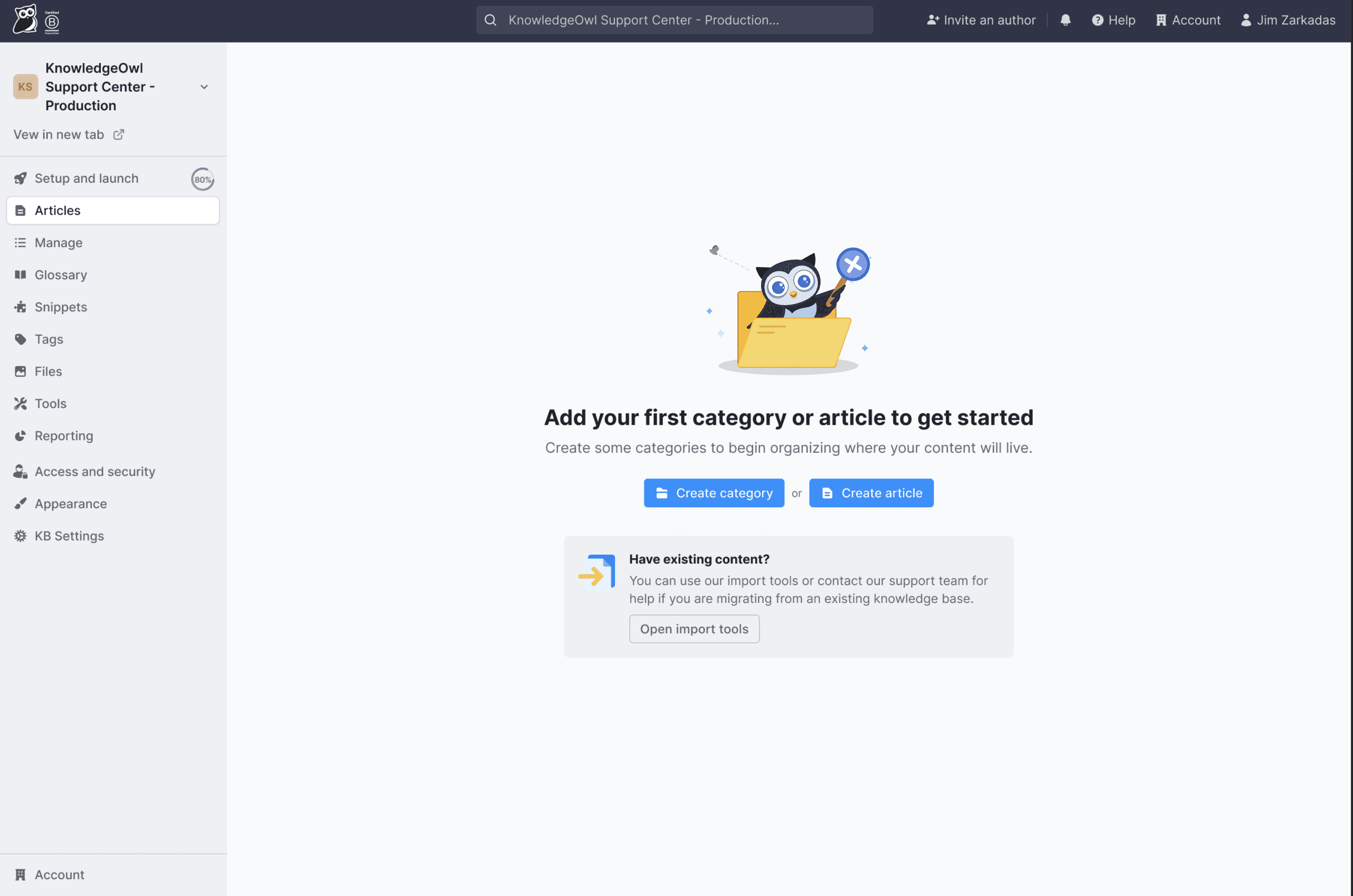
Try the knowledge base software your team will fall in love with
Reduce tickets, make information easy to find.
Happier employees, happier customers.
3
Become the tech writer everyone respects
Check out our podcast, The Not-Boring Tech Writer.
How teams are using KnowledgeOwl
Loved by 3,200+ knowledge base authors in software companies around the world