All articles
STC Summit – How sketching is like technical communication by Elizabeth Alley
Professional artist and technical writer Elizabeth Alley shares her top tips on how sketching can help us be better technical communicators.
Published
Category
STC Summit – How sketching is like technical communication by Elizabeth Alley
Catherine Heath | May 10, 2019
“How sketching is like technical communication” was an incredible talk that kicked off the STC Summit for me. Delivered by technical writer and artist Elizabeth Alley, in this talk we learned how she has used her sketching skills to become a better technical writer.
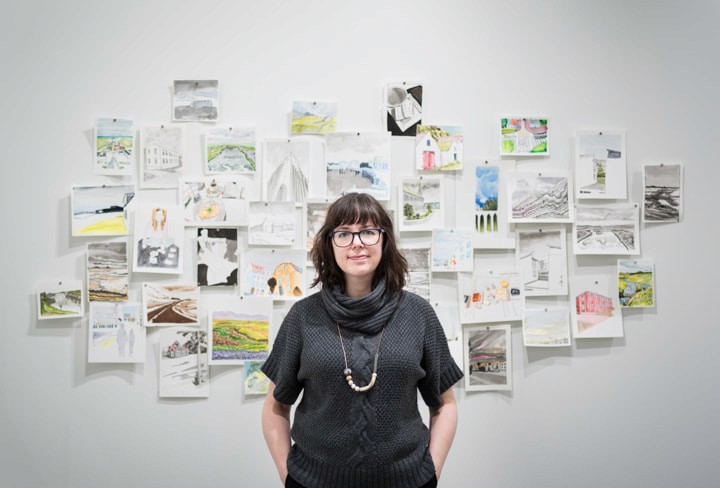
Elizabeth has nine years experience as a technical writer, and she studied Fine Arts in painting at the University of Memphis. Elizabeth has had many exhibitions of her artwork and also teaches at Flicker Street Studio.
Everyone is an artist
In this context, a sketch is an observational drawing. It’s a quick illustration that you make of something directly in front of you. “I’ve carried a sketchbook since the late nineties like a security blanket,” says Elizabeth.
Elizabeth’s talk was very much aimed at people who do not identify themselves as artists, and may even be afraid to draw something.
In response to the idea that someone can’t draw, she says that when we’re children, we all draw without being self-conscious. We don’t construct barriers for ourselves about what we can or can’t do. Inability to draw is a learned response that we pick up, but we can go back to the open and explorative attitudes that we had as children.
You don’t even have to draw works of art to use sketching in your work. The “glyphic mode” is another term for drawing in stick figures, and even this level of artistic expression is sufficient for improving information recall. “Don’t be afraid to be ridiculous,” says Elizabeth.
Sketching and its benefits
Doodling is not an activity that is particularly expected in the workplace, and some people may give you funny looks. But sketching during the course of your work actually has many benefits.
Sketching strengthens the hand to brain connection, and sketching helps you capture what you felt at the time in a way that photographs can’t. It improves information recall because you’re making a conscious effort to interpret what you’re hearing, and translate words into a visual medium. Sketching is also a tool to communicate information more effectively.
Looking back over your notes is easier this way, because our brains naturally process information visually. You can draw boxes around your notes to make certain sentences stand out. Make use of mind maps, arrows, tables, and underlining.
This technique is also known as the “rapid visualization of words and concepts” and “applied visual thinking” according to Sonny Brown. You can draw maps to help yourself remember directions.
Resources and tips for sketching
Elizabeth recommended many excellent books for people who want to learn more about sketching:
The Back of the Napkin – Dan Roam
Syllabus: Notes from an Accidental Professor – Lynda Barry
The Doodle Revolution: Unlock the Power to Think Differently – Sunni Brown
Art of Learning – Michiko Maruyama
We need to take observational drawing out of the studio and into the field. You have limited time to express what you saw so it forces you to strip it down to the most essential elements. It makes any subject potentially more interesting.
Quick tips for sketching:
Start at the top of your sketch
To translate shapes into lines, you can close one eye and measure distance with your pencil. This same length is the length of the line you should draw.
You can join Urban Sketchers, a community of people into sketching
Share your “less-than-good” drawings to help newcomers
As with any practical skill you want to learn, practice makes perfect.
Improving communication and recall
We all need to make sketching more acceptable in the workplace to broaden the methods we use to express, capture, and communicate information.
Elizabeth’s recommendations helped me to stay more present during the talks in the conference, and take better notes to look back over afterwards. It was a great first session to attend.
Check out this write-up by our community builder Catherine's overall experiences of STC Summit.
Our very own knowledge base software KnowledgeOwl can help you create delightful documentation for your users. Take it for a free spin now.

Written by
Catherine Heath
Catherine is a freelance writer based in Manchester who writes blogs, social media content, and copy. She also designs owl-based images. 🦉

Follow these 3 steps to improve your knowledge base
1
Get expert tips every month in your inbox
No spam, pinky promise.


2
Try the knowledge base software your team will fall in love with
Reduce tickets, make information easy to find.
Happier employees, happier customers.

3
Become the tech writer everyone respects
Check out our podcast, The Not-Boring Tech Writer.
How teams are using KnowledgeOwl
Loved by 3,200+ knowledge base authors in software companies around the world