All articles
The ultimate knowledge base software buying guide, part 1
Stop wasting time on knowledge base demos that don't fit your needs. Define your audience, author team, and requirements first with our step-by-step guide.
Published
Category

Define your audience, your authors, and the problem you are solving.
Know what you need before you start shopping
Choosing the right knowledge base software can feel overwhelming. With dozens of options claiming to be the "best," how do you find the one that actually fits your team's needs?
The secret? You need to know exactly what you're looking for before you start looking.
After ten years of helping organizations build better knowledge bases, we've learned that the most successful implementations start with clear requirements. Skip this step, and you'll waste weeks demoing tools that were never going to be a good fit. This guide will help you define your requirements so you can evaluate options efficiently and confidently.
What is knowledge base software?
Knowledge base software is a specialized tool designed to create, organize, and share information with specific audiences. Unlike general content management systems or document storage tools, knowledge base software is purpose-built to help people find answers quickly through features like powerful search, logical organization, and access controls.
Companies use knowledge bases for customer support documentation, internal process guides, technical documentation, training materials, and more.
Step 1: Define your primary audience(s)
Before you look at a single demo, answer this critical question: Who will be using your knowledge base to find information?
Your answer determines which features will matter most to you.
External/customer-facing audiences
If you're creating documentation for customers, clients, or the general public, you'll likely need:
Public accessibility with optional authentication
SEO optimization to attract new customers through search engines
Branded, professional design that matches your company website
Analytics to understand customer behavior and content gaps
Integration with support ticketing systems
Internal audiences
If you're documenting processes, policies, or technical information for employees, you'll likely need:
Robust access controls and permissions
SSO integration with your existing systems (Google Workspace, Okta, Azure AD)
Content versioning and approval workflows
Search across large volumes of documentation
Tools to prevent knowledge loss when employees leave
Both internal and external audiences
This is actually the most common scenario, and it requires the most sophisticated permission system. You'll likely need:
Granular reader group permissions to show different content to different audiences
The ability to maintain public and private content in one system
Multiple knowledge base options within one account
Flexible authentication options (public, SSO, custom login)
Why this matters: Many knowledge base platforms specialize in one audience type or the other. Trying to force a customer-only tool to work for internal docs (or vice versa) is a fast path to frustration. Knowing your audience(s) upfront helps you eliminate options that simply won't work.
Step 2: Identify your author team
How will content be created and maintained? More specifically: Who will create and maintain your knowledge base, what's their experience level, and how many of them are there?
Your answers will determine which authoring features and workflows you need.
Dedicated documentation team
If you have professional technical writers or a dedicated documentation team, they'll likely want:
Advanced content editing features
Version control and article drafts
Bulk editing capabilities
Article status tracking (published, needs review, archived)
Content reuse features (snippets, variables)
Advanced formatting and structure options
Why these features matter: Professional writers value efficiency and control. They're comfortable with complexity if it makes them more productive.
Support team as authors
If your support team writes knowledge base articles between customer interactions, prioritize:
A simple, intuitive editor that requires minimal training
Quick article creation without complex workflows
Template options to speed up article creation
The ability to track which articles reduce tickets
Style guide tools and checkers to maintain consistency
Why these features matter: Support team members need to create content quickly without context-switching from their primary job. Simplicity wins over advanced features.
Developers as authors or reviewers
If developers will contribute documentation or review technical content, they may want:
Markdown support or docs-as-code workflows
Integration with Git and version control systems
API documentation tools
Code block support with syntax highlighting
Automatic linting tools to enforce consistency
Why these features matter: Developers already have workflows that work for them. Documentation tools that integrate with those workflows get more adoption than tools that require them to learn something completely new.
Note: This use case typically leads teams toward specialized developer documentation platforms rather than general knowledge base software. To say, if this is what you’re looking for, you likely don’t want to use a platform like KnowledgeOwl.
Collaborative/wiki-style creation
If many team members across departments contribute content occasionally, look for:
A low learning curve for casual users
A clear organization system that prevents content chaos
Review workflows to maintain quality without bottlenecking
Good search so authors can find existing content before duplicating
Clear ownership and notification systems
Why these features matter: When everyone is an author, you need guardrails that maintain quality without creating friction. Too complex, and people won't contribute. Too loose, and you get chaos.
Note: These types of software are usually a pay per “user”, where authors and readers are counted and one in the same. All readers contribute, rather than having a specialized team of authors.
Small team or solo author
If you're a team of one or two, you need:
Straightforward setup without requiring technical expertise
Excellent customer support to help when you're stuck
Reasonable pricing for smaller teams
The ability to scale as you grow without having to switch platforms
Why these features matter: You don't have time to become a knowledge base expert. You need something that works out of the box with minimal configuration.
Note: In the beginning you may not understand all the features available within a software, so ask Support or Success if they have features that are useful as your content and company grows.
Step 3: Map audiences and authors to features
Now that you know your audiences and authors, create a simple list of features that matter for your specific situation.
Here's how to think about it:
For each audience you identified:
What access controls do they need?
How will they authenticate?
What analytics do you need about their behavior?
What integrations would improve their experience?
For each author group you identified:
What editor experience do they need?
What workflows will help them create content efficiently?
What tools will help maintain quality?
How should content review and approval work?
Don't worry about whether specific platforms have these features yet—that comes later. Right now, you're just creating your requirements list.
Step 4: Prioritize your requirements
Not all features are equally important. Before you start evaluating platforms, categorize your requirements:
Must-have features (dealbreakers)
These are non-negotiable. If a platform doesn't have these, it's eliminated immediately.
Examples might include:
"Must support both public and private content"
"Must integrate with our SSO provider"
"Must have granular access controls"
Important features (strong preference)
You really want these features, and their quality will influence your decision, but you might compromise if everything else is excellent.
Examples might include:
"Advanced analytics"
"Content reuse features"
"Article templates"
Nice-to-have features (bonus)
These would be great, but you can work without them.
Examples might include:
"AI writing assistance"
"Custom CSS support"
"Broken link checker”
This prioritization prevents you from either eliminating good options over minor issues or selecting a platform that lacks critical features you will need later.
Common mistakes in defining requirements
Mistake #1: Copying someone else's requirements
Your colleague's company uses Tool X and loves it. That doesn't mean it's right for you. Their audience, team structure, and priorities are different from yours.
Mistake #2: Starting with features instead of needs
Don't start by listing cool features you've seen. Start with your actual needs, then find features that address them. What are the main problems you need the software to solve?
Mistake #3: Forgetting about growth
Think 2-3 years ahead:
Will you add new audiences?
Will your team grow?
Might you add new types of content?
Choose something that can scale with you, even if you don't need all its capabilities today.
Mistake #4: Involving only one stakeholder
The person requesting the knowledge base isn't always the person using it daily. Talk to:
The people who will write and maintain content
The people who will read the content
Anyone who needs to approve the purchase
Next steps
Once you've completed this requirements definition process, you're ready to efficiently evaluate knowledge base platforms. You'll be able to quickly eliminate options that don't fit and focus your time on platforms that might actually work for your needs.
In part 2 of our knowledge base software buying guide, we'll walk through exactly how to assess whether platforms meet your requirements, what to look for in demos and trials, and how to make your final decision.
Ready to see if KnowledgeOwl meets your requirements? We offer a generous free trial with no credit card required. Start your trial or schedule a personalized demo to see if we're the right fit for your team.


Follow these 3 steps to improve your knowledge base
1
Get expert tips every month in your inbox
No spam, pinky promise.


2
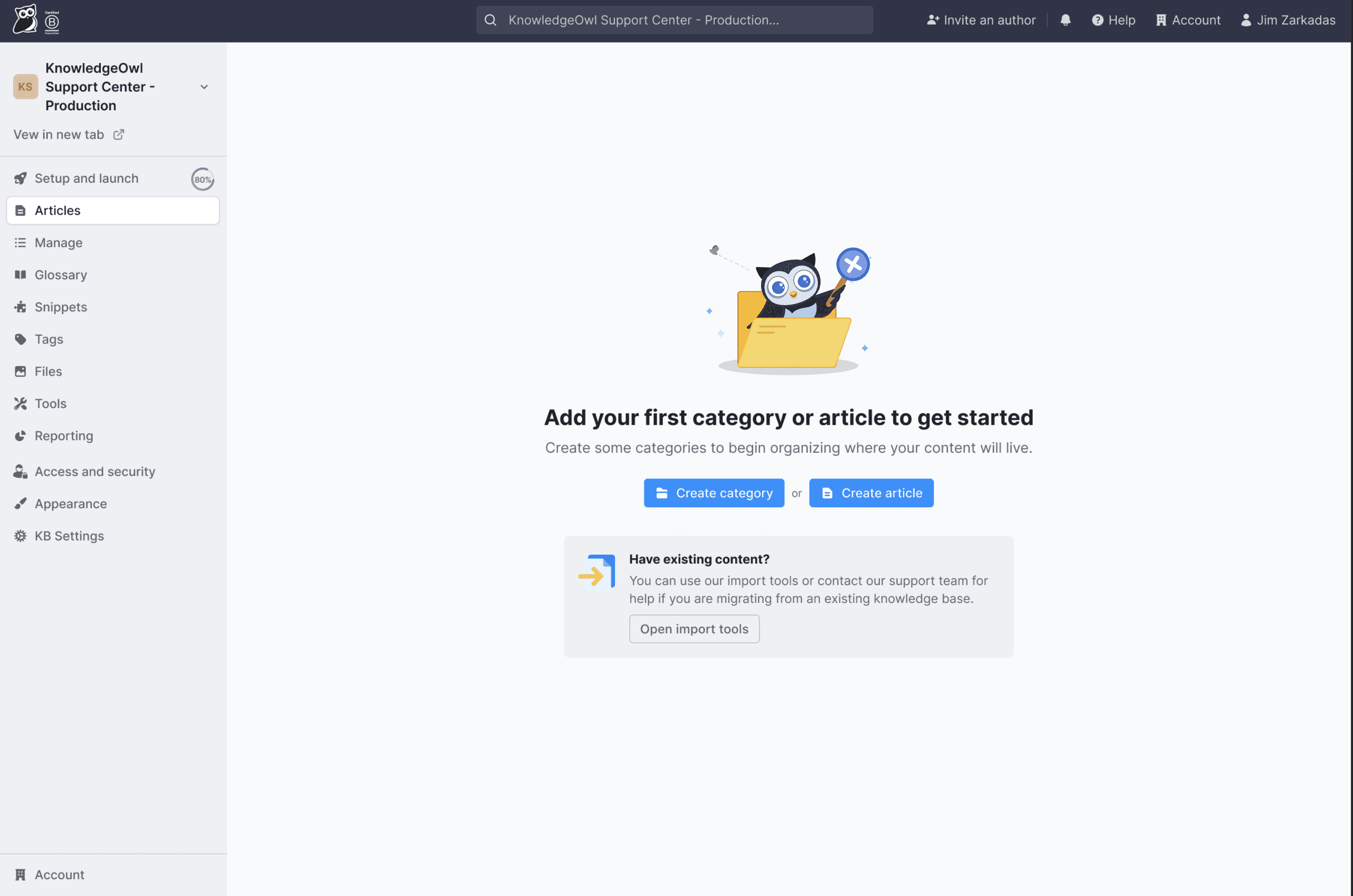
Try the knowledge base software your team will fall in love with
Reduce tickets, make information easy to find.
Happier employees, happier customers.
3
Become the tech writer everyone respects
Check out our podcast, The Not-Boring Tech Writer.
How teams are using KnowledgeOwl
Loved by 3,200+ knowledge base authors in software companies around the world