All articles
How software documentation systems can transform how work is done
How documentation systems transform knowledge sharing: reduce support tickets, cut onboarding time, and stop knowledge from walking out the door.
Published

Here's something that probably sounds familiar: someone on your team goes on vacation, and suddenly everyone's scrambling because they're the only one who knows how to do... that thing. Or you spend half your morning hunting through Slack messages trying to find something someone definitely told you three months ago. Or a new hire asks you the same question you've answered seventeen times already this year.
This is the reality of working without good knowledge base software. Critical knowledge lives in people's heads, buried in email threads, or scattered across a dozen different tools. And it costs you - in time, in productivity, and in the very real frustration of constantly reinventing wheels.
A documentation system changes this. Not in a magical, solve-all-your-problems way, but in a very practical, day-to-day work-actually-gets-easier way. It gives you one place to put knowledge, one place to find it, and one way to make sure it doesn't disappear when someone leaves or goes on parental leave.
Real research backs this up, too. Research published in peer-reviewed journals shows that knowledge management processes significantly improve organizational performance across quality, operational, and innovation metrics. Companies with solid knowledge bases see support tickets. Organizations that get their teams collaborating well through shared knowledge see real performance improvements - employees report working better when they can actually collaborate.
Why documentation matters for knowledge sharing
Knowledge sharing is really just about getting information from the people who have it to the people who need it. Sounds simple, right? But in practice, it's messy. Someone figured out how to solve a tricky problem, but they solved it quietly at their desk and never told anyone. A customer support agent discovers a workaround, but it stays in their personal notes. A developer writes code that does something clever, but six months later no one remembers how it works.
When you have a documentation system that actually works, things start to shift. Information becomes findable - you can search for it instead of interrupting someone's deep work time. Knowledge sticks around even when people move on to new roles or new companies. And one person's hard-won expertise can help everyone, not just the three people who happen to sit near them.
Without good documentation, you get what researchers call "knowledge hoarding." Usually it's not intentional - people aren't being secretive, they just never got around to writing things down, or they didn't realize anyone else needed to know. But the effect is the same: bottlenecks. Support agents waiting for the one person who knows how to handle a specific issue. Teams accidentally doing the same work twice because they didn't know it was already done. Technical writers trying to document features without any idea how they actually work.
A documentation system creates a single source of truth. Everyone can see what's known, what questions keep coming up, and where the gaps are. That visibility matters more than you might think.
Breaking down silos (without making everyone hold hands)
Silos happen naturally as companies grow. You specialize, you create departments, and before you know it, teams are working in parallel universes. When the marketing team is selling the product in ways that make zero sense, and Support ends up having to explain to customers that they're in the wrong place. It's one of those organizational problems that everyone complains about and no one quite knows how to fix.
But documentation systems actually help with this. They create bridges between teams without requiring everyone to be in constant meetings.
Here's a typical scenario: Your support team sees the same issue coming up over and over in tickets. But they're not sure how to tell the product team in a way that gets prioritized. The product team doesn't realize how often customers hit this problem. Technical writers don't know the issue exists, so the documentation doesn't mention it. Sales keeps promising customers something that doesn't quite work the way they think it does.
Now imagine that same scenario with a shared documentation system. Support documents the issue and the workaround they've found. Product can see exactly how often it comes up and what the customer impact is. They can update the status where everyone can see it. Technical writers notice the change and update the help docs. Sales sees accurate, current information about what actually works.
But here's what's even better: when teams can see each other's documentation, they start to understand each other better. Product managers get a real sense of what support deals with daily. Support agents understand why certain things are technically hard to fix. This kind of mutual understanding leads to better collaboration without needing a trust fall exercise.
Getting new people up to speed faster
The time it takes for a new hire to become productive - what some people call "time-to-proficiency" - has a real cost. Traditional onboarding is heavy on shadowing, scheduled training sessions, and figuring things out through trial and error. It works, but it's slow and inconsistent.
Good documentation completely changes onboarding. New people can access everything they need to know on day one. They're not waiting for training sessions or feeling bad about interrupting busy coworkers. They can learn at their own pace and come back to complex topics as many times as they need to.
The benefits go beyond speed, though. Standardized documentation means everyone gets the same information, which prevents those weird situations where different new hires were taught completely different approaches. It allows self-paced learning, so people aren't pretending to understand something in a group training session and then having to figure it out secretly later.
For support teams specifically, documentation is like a safety net for new agents. When they get a challenging ticket early on, they can search for similar past issues, find approved responses, and understand when to escalate. That immediate access to institutional knowledge reduces stress and helps people feel effective instead of lost.
Good onboarding documentation should cover what some people call the "5 C's": Compliance (policies and legal requirements), Clarification (what your role actually is), Culture (how things work around here), Connection (who to talk to about what), and Check-back (how you'll get feedback and keep learning).
Some companies even do "preboarding" - giving new hires access to documentation before their first day so they can complete admin tasks and arrive ready to actually start working.
With remote work, this becomes all the more imperative, too. I was the first Europe-based hire for a Canadian SaaS company many years ago. I had two weeks of training working hours more adjacent to my Toronto-based colleagues, but after that I was on my own. I worked the first 6 hours of every day solo in the inbox, depending completely on our Help Center, and internal documentation. I made a decision to document every single I learned via asking instead of via documentation, and from there future hires were able to find what I couldn't — and experienced much less stress than I did when I started. To tell you the truth, that experience is what drew me to working for KnowledgeOwl later, I understand profoundly just how life-changing good documentation can be for employees.
Reducing support tickets through self-service
If you run a customer support team, ticket volume is always on your mind. Each ticket represents time, cost, and a customer who needed help. A good knowledge base - one your customers can actually access and use - can dramatically reduce this through self-service.
Companies with mature knowledge bases see an drastic reduction in support tickets. Again, I can attest to this personally. My last company put a larger effort into the Help Center, and our ticket volume went way down, and our jobs became a lot more interesting.
Instead of staring into the void, while answering the same question for the nine-hundredth time that month, I was getting fun problems to solve. I was able to give better service to those who had real challenges instead of playing whack-a-mole with text snippets of the same answers.
The cost savings are significant. According to Gartner's 2019 Customer Service and Support Leader poll, self-service costs about $0.10 per contact compared to $8.01 for live channels.
But here's what surprised me: when customers can find answers themselves, satisfaction actually goes up. Coleman Parkes research for Amdocs showed 91% of customers will use a knowledge base if it were tailored to meet their needs. They prefer the immediacy of self-service over waiting for responses, especially for simple questions. This creates a virtuous cycle - as your knowledge base improves, more customers successfully self-serve, which frees your agents to handle the complex issues that actually need human judgment and empathy.
For your support team, this means less time answering the same question for the hundredth time and more time on interesting challenges where they add real value. This reduces burnout, increases job satisfaction, and improves retention.
But - and this is important - quality matters enormously. According to Gartner research, 43% of self-service failures occur because customers can't find relevant content. If customers can't find accurate answers quickly, they'll abandon the knowledge base and contact support anyway, now frustrated by the failed attempt. This is why choosing a system with intelligent search - one that understands natural language, tolerates typos, and actually surfaces relevant content - is critical.
Modern knowledge base platforms use AI-powered semantic search that goes beyond simple keyword matching. These systems understand context and intent. Someone searching for "how to reset password" gets the same results as someone typing "can't log in" or "forgot my password" - the system recognizes these are related even though the words are different.
Preventing knowledge loss when people leave
People leave jobs. It's inevitable. And when experienced team members go, they take years of knowledge with them - unless you've captured it in documentation.
Without proper documentation, this "brain drain" can really hurt. The people who remain have to figure out everything from scratch, rediscover solutions, and repeat mistakes that someone already learned from.
A documentation system acts as organizational memory. Knowledge persists beyond individual tenure. This becomes especially valuable during change - restructuring, rapid growth, or unexpected departures.
The process of documenting often reveals gaps you didn't know existed. When experienced employees write down their expertise, they frequently discover processes that exist only in their heads with no backup plan. This realization prompts proactive knowledge capture before it becomes urgent.
Documentation also makes succession planning smoother. When someone plans extended leave or a role transition, comprehensive documentation gives their replacement a roadmap instead of a blank slate. This maintains quality and reduces disruption.
For distributed or remote teams - which is most teams now - documentation becomes even more critical. When you're working across time zones asynchronously, you can't rely on real-time knowledge transfer. Well-documented processes let teams work effectively regardless of when or where they're located.
Documentation systems also protect you from over-relying on "hero" employees - those people who seem to have all the answers and become bottlenecks. By capturing and sharing their knowledge broadly, you distribute expertise across the team and eliminate single points of failure.
Using documentation data to make better decisions
Modern documentation systems don't just store information - they provide analytics that inform strategic decisions. You can track what users search for, which articles get the most views, where people struggle to find answers, and what gaps exist in your documentation.
High search volume for topics without corresponding articles? That's a content gap. Articles with lots of views but low satisfaction scores? That content needs improvement. Common search terms that yield no results? Your documentation isn't meeting user needs.
These insights let you prioritize documentation efforts based on actual data rather than guesswork.
Documentation systems also show you patterns in how knowledge flows through your organization. You can identify which teams actively contribute and share versus which stay siloed. You can see which documentation gets reused across teams, indicating valuable cross-functional knowledge.
In customer support, documentation analytics correlate directly with support metrics. Compare ticket volume trends with knowledge base article creation and updates to measure the impact of documentation improvements. This gives you concrete evidence of ROI.
Some useful metrics to track:
Deflection rate - the percentage of knowledge base searches that don't result in support contacts. Article effectiveness - ticket reduction after publishing or updating articles. Time-to-resolution - how quickly agents solve tickets with versus without documentation. Content quality scores from user ratings and feedback. Search success rate - how often searches result in article views.
These metrics transform documentation from a "nice to have" into a quantifiable driver of business outcomes.
Bonus: If you want to learn more about the importance of analytics in your knowledge base you can see my article: The importance of robust reporting in your knowledge base.
How documentation fosters innovation
Innovation doesn't happen in isolation. The best solutions come from people with different perspectives building on each other's ideas. Documentation systems facilitate this by making diverse knowledge accessible and discoverable.
This study published in the International Journal of Productivity and Performance examined knowledge management processes including "storage and documentation" and found that KM processes significantly influence innovation capability, which in turn affects organizational performance
When team members can easily explore what others have tried, learned, and solved, they don't start from zero. They see patterns, identify opportunities to apply solutions from one domain to another, and build on proven approaches.
Many organizations create specific spaces in their documentation for innovation-focused content: lessons learned, project post-mortems, experiment results, idea repositories. These become valuable resources that inform future work and prevent repeating past failures.
The transparency documentation creates also encourages experimentation. When teams know their learnings will be captured and shared, they're more willing to try new approaches. Even failures become valuable if the lessons are documented. This creates a culture where calculated risk-taking is encouraged and learning from mistakes is normalized.
For support teams, this might mean new troubleshooting techniques, creative solutions to edge cases, or improved customer communication strategies. When one agent discovers something effective, documentation ensures it benefits everyone.
How to make documentation second nature
Understanding documentation's benefits is one thing. Actually implementing it is another. Success requires cultural change, consistent practices, and ongoing commitment.
Start by establishing clear standards. Define what should be documented, how it should be structured, what level of detail is appropriate, and how often it should be reviewed. Without these guidelines, documentation becomes inconsistent and hard to use.
When I led a Customer Experience team I implemented a "rule" that if you asked a question, you then had to add its answer to our internal knowledge base. It was understood that when you received an answer, you then were given extra time, on the spot, to document that answer.
Create accountability. In most organizations, documentation is seen as optional - something people do when they have "extra time." This ensures it never happens. Instead, build documentation into workflows and job expectations. For support teams, this might mean documenting new issues as tickets are resolved.
Make documentation easy. The harder it is to create and maintain documentation, the less people will do it. Choose systems with intuitive interfaces, templates for common content types, and workflows that fit naturally into existing processes.
Make documentation discoverable. Comprehensive documentation provides no value if people can't find it. Implement powerful search that understands natural language, tolerates typos, and learns from user behavior. Organize content logically with clear categories, tags, and relationships between articles.
Encourage continuous improvement. Documentation should be living content, not static artifacts. Use analytics to identify outdated or low-performing content. Create feedback mechanisms so users can report issues or suggest improvements.
Here at KnowledgeOwl, the owl in charge of our docs, is excited for when a new hire can give her feedback. If a new hire feels safe and comfortable, they can be a wealth of information. When they cannot find the answer to something it can signal a gap in information, or just a place where discoverability could be improved.
Recognize and reward documentation contributions. When people see that documentation efforts are valued, they're more likely to prioritize them. This recognition might be formal (performance evaluations) or informal (team shoutouts).
Measuring Return on Investment (without made-up numbers)
For decision-makers, ROI inevitably comes up. And honestly? A lot of the statistics floating around about documentation ROI are dubious at best. So instead of citing claims that come from marketing sites, let me give you a simple framework for calculating ROI based on your actual numbers.
The framework that actually works:
Pick your biggest pain point and measure it for one month. For support teams, that might be tracking your top 10 ticket types and calculating how many could be deflected by good documentation. Even deflecting just 25% of simple questions adds up fast - use your real ticket volume and cost per ticket to calculate the savings.
For development teams, have people track interruptions for a week. Each "quick question" doesn't just cost the 2-minute answer - it costs 10-15 minutes of lost focus time. Multiply interruptions per day × time lost × developer hourly rate × team size. You might be surprised how much this costs annually.
For onboarding, compare time-to-productivity for recent hires. If good documentation shaves even a few weeks off your onboarding timeline, that's significant savings multiplied by every new hire.
The honest pitch for budget approval:
When asking for budget, use this approach: "Based on tracking our own numbers, we have [specific pain point] that costs us approximately [calculated amount] per month. Documentation could address [realistic percentage] of this, saving roughly [conservative estimate] annually."
You don't need to prove every benefit - just 2-3 strong calculations with your real data. That's far more convincing than citing questionable blog post statistics.
Start conservatively, measure actual results, and let the ROI prove itself over time.
Building a knowledge-sharing culture
Ultimately, documentation systems enable something more important than operational efficiency: a culture where knowledge sharing is valued and expected.
Organizations with strong knowledge-sharing cultures attract and retain top talent. People want to work where they can learn, grow, and contribute meaningfully. Comprehensive documentation and transparent knowledge sharing make new employees feel supported. It becomes a retention factor for people considering leaving.
These organizations also demonstrate greater agility. When conditions change or new opportunities emerge, companies with robust documentation can pivot quickly. They don't need to reinvent processes - they build upon established knowledge.
Customer experience improves measurably. When every support agent has access to the same knowledge base, customers receive consistent, accurate information. When customers can self-serve effectively, they feel empowered and satisfied.
For support teams, knowledge-sharing cultures reduce the stress and burnout that plague the profession. When agents know they have reliable resources, difficult tickets become less daunting. When new agents can find answers independently, they build confidence faster. When institutional knowledge is preserved, losing experienced team members doesn't create panic.
Choosing the right platform
With the importance of documentation established, the practical question becomes: which system should you use?
Key capabilities to evaluate:
Search functionality - AI-powered semantic search that understands natural language delivers dramatically better results than simple keyword matching. Look for typo tolerance, autosuggest, and customizable search behavior.
Customization options - Your documentation should reflect your brand and integrate into your ecosystem. Platforms offering control over CSS, HTML, and JavaScript enable you to create experiences that feel native.
Security and access control - Different audiences need different information. Look for robust permission systems that let you create internal documentation, customer-facing help centers, and confidential content in one platform with appropriate access controls.
Analytics and insights - Data-driven improvement requires comprehensive analytics showing what users search for, which content performs well, where gaps exist, and how documentation impacts business metrics.
AI assistance - Modern platforms leverage AI for search, content creation support, automated tagging, chatbot functionality, and identifying gaps based on usage patterns.
Scalability - As you grow, your documentation needs will evolve. Choose platforms built to handle increasing content, users, and complexity without performance issues.
For organizations focused on customer support and technical documentation, specialized knowledge base platforms often provide better value than general-purpose solutions. These platforms understand the specific workflows, metrics, and challenges of support teams.
Moving forward
Implementing a documentation system isn't just a technology project - it's an organizational change initiative that requires planning, commitment, and ongoing attention.
Begin with a clear vision of success. Define specific, measurable objectives: reduce ticket volume by X%, decrease onboarding time by Y weeks, achieve Z% self-service resolution. These goals provide direction and let you measure progress.
Secure executive sponsorship. Knowledge management succeeds when leadership actively supports it through resource allocation and by modeling desired behaviors. When executives contribute to documentation and publicly value knowledge sharing, everyone follows.
Start with high-impact content. Rather than documenting everything at once, identify the knowledge that delivers the most value: answers to frequently asked questions, solutions to recurring issues, critical processes that create bottlenecks. Quick wins build momentum.
Build documentation into workflows. Sustainable documentation happens as part of regular work, not as separate activities.
Invest in training. Simply providing tools doesn't ensure people will use them effectively. Offer training on documentation best practices, search techniques, content organization, and writing for different audiences.
Measure, analyze, iterate. Use analytics to continuously improve. Identify gaps, update outdated content, recognize contributors, and demonstrate impact through meaningful metrics.
Celebrate successes. When documentation leads to faster resolution, successful self-service, or improved onboarding, share these stories. Recognition reinforces value and motivates continued effort.
The organizations that thrive aren't necessarily those with the smartest individuals - they're the ones that most effectively capture, share, and leverage collective knowledge. A documentation system provides the foundation for this, transforming isolated information into organizational intelligence.
For leaders responsible for team effectiveness, the question isn't whether to invest in documentation systems - it's how quickly you can start realizing the substantial, measurable benefits they provide.
If you're ready to give a purpose-built knowledge base software out to improve your life, the lives of your colleagues, and the lives of your customers, give KnowledgeOwl a go. The trial is free, and we'll help you with finding the right solution for your needs (even if it isn't us!)


Follow these 3 steps to improve your knowledge base
1
Get expert tips every month in your inbox
No spam, pinky promise.


2
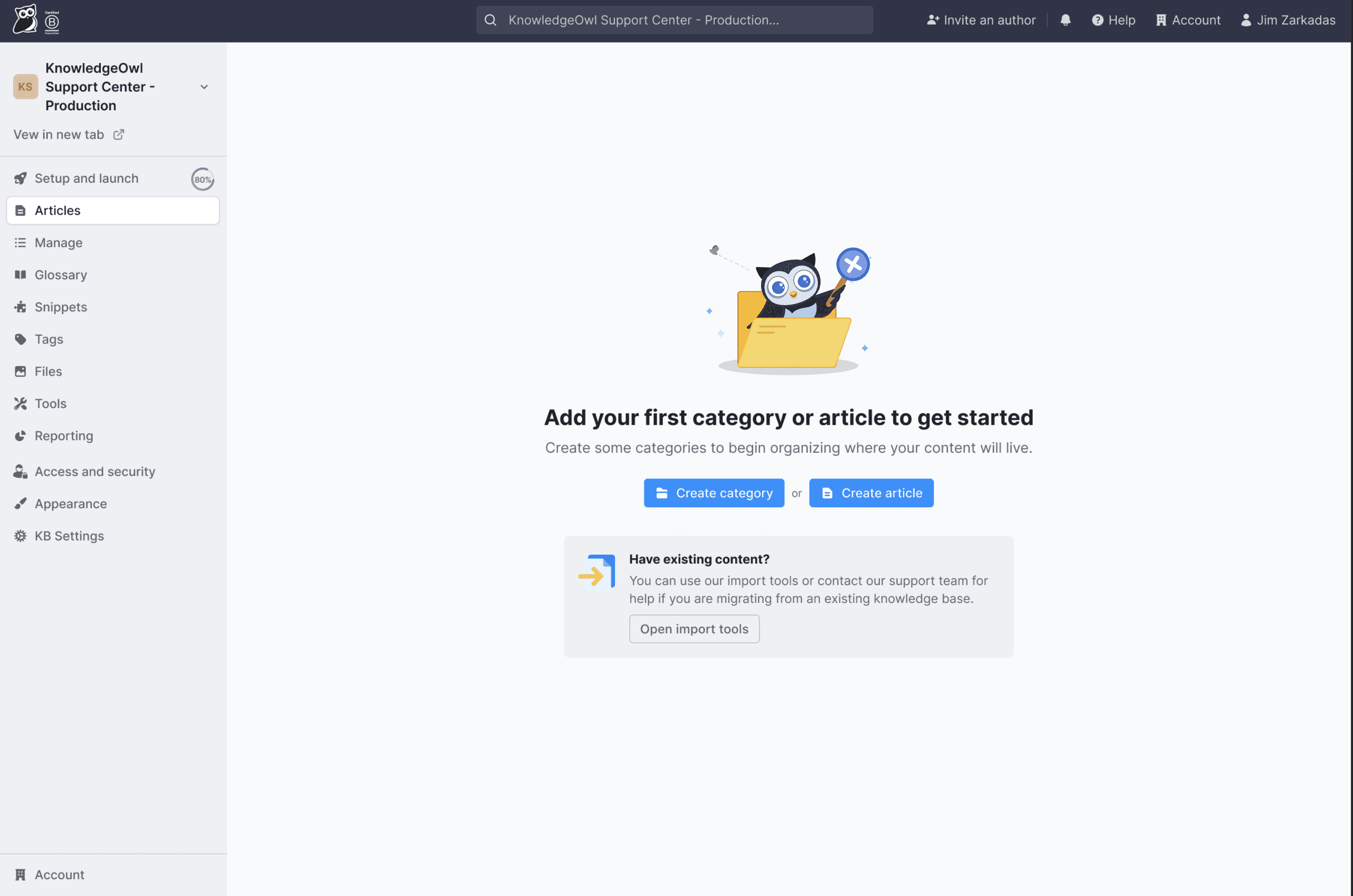
Try the knowledge base software your team will fall in love with
Reduce tickets, make information easy to find.
Happier employees, happier customers.
3
Become the tech writer everyone respects
Check out our podcast, The Not-Boring Tech Writer.
How teams are using KnowledgeOwl
Loved by 3,200+ knowledge base authors in software companies around the world